October 15, 2026
Osteoarthritis can affect the joints of the feet and ankles, causing pain, stiffness, swelling and reduced mobility. Because your feet contain many small joints that work together when you stand and walk, arthritis in one area can also change how the foot moves and bears weight.
Treatment focuses on managing symptoms, maintaining mobility and helping you stay active. Depending on your symptoms, this may include exercise, footwear changes, activity modification, rehabilitation, pressure relief and, for some people, custom orthotics.
At Feet First Clinic, a foot assessment can help identify what may be contributing to your symptoms and determine which treatment options may be appropriate.
Key Takeaways
Osteoarthritis can affect the big toe, midfoot and ankle.
Common symptoms include pain, stiffness, swelling and reduced joint movement.
Arthritis can change how your foot moves and distributes pressure when you walk.
Treatment may include exercise, footwear changes, activity modification, rehabilitation and pressure relief.
Custom orthotics may help some people by redistributing pressure or supporting foot mechanics, but they are not appropriate or necessary for everyone.
A foot assessment can help identify the source of your symptoms and guide treatment.
What Is Osteoarthritis?
Osteoarthritis (OA) is a condition involving changes within and around a joint. It is sometimes described as "wear and tear," but that description is overly simplistic.
A joint contains several structures that work together, including cartilage, bone, ligaments, the joint capsule, and surrounding tissues. With osteoarthritis, the joint can undergo structural and inflammatory changes that contribute to pain, stiffness, and reduced function.
Osteoarthritis can affect many joints, including:
The big toe joint
The smaller toe joints
The joints in the middle of the foot
The ankle
The joints between the heel and midfoot
Other joints throughout the lower limb
Osteoarthritis does not look the same in everyone. Some people have significant changes visible on imaging but relatively little pain, while others can experience considerable pain and functional limitations.
This is one reason that treatment should be based on the person's symptoms, examination, activity level, and functional goals—not simply an X-ray.
How Does Osteoarthritis Affect the Feet?
The feet contain numerous joints that allow them to adapt to the ground, absorb forces, and help propel the body forward.
When osteoarthritis affects one of these joints, normal movement can become painful or restricted.
For example, if the big toe joint becomes stiff, the toe may have difficulty bending upward during the push-off phase of walking. The body may then compensate by changing how the foot, ankle, knee, or hip moves.
Similarly, arthritis in the midfoot can make it uncomfortable for the foot to adapt to uneven surfaces or tolerate prolonged standing and walking.
Figure 1: How Foot Osteoarthritis Can Affect Walking
Osteoarthritis in one foot joint can affect how the foot moves and loads during walking. The resulting changes vary from person to person and do not necessarily mean that arthritis is progressing throughout the foot.
Where Does Osteoarthritis Commonly Occur in the Foot?
1. Big Toe Joint
Osteoarthritis of the big toe joint is often called first metatarsophalangeal joint osteoarthritis.
It may also be associated with a condition called hallux rigidus, which refers to reduced movement and stiffness of the big toe joint.
Common symptoms include:
Pain at the base of the big toe
Stiffness
Difficulty bending the toe upward
A bump or enlargement around the joint
Pain when pushing off while walking
Difficulty wearing certain shoes
Pain during activities that require the toe to bend
A stiff big toe can change the way a person rolls through the foot during walking.
2. Midfoot
The midfoot contains several joints that help the foot adapt to different surfaces and distribute forces.
Midfoot osteoarthritis may cause:
Aching across the top or middle of the foot
Stiffness after periods of inactivity
Pain during prolonged standing or walking
Swelling around affected joints
Difficulty wearing shoes that put pressure across the top of the foot
A change in the shape of the foot over time
Some people develop a bony prominence across the top of the foot that can become irritated by footwear.
3. Ankle
Osteoarthritis can also affect the ankle joint.
Ankle arthritis may cause:
Pain with walking
Morning or activity-related stiffness
Reduced ankle movement
Swelling
Difficulty walking on uneven surfaces
Difficulty with stairs
Changes in walking mechanics
Ankle osteoarthritis can have different causes, including previous ankle injuries or fractures.
What Does Foot Osteoarthritis Feel Like?
The symptoms of osteoarthritis vary depending on which joint is affected and how much it is being loaded.
Common symptoms include:
Pain
Pain may occur during:
Walking
Standing
Running
Going up or down stairs
Pushing off the toes
Certain movements of the foot
Wearing particular shoes
Some people also experience pain after activity rather than during it.
Stiffness
Joint stiffness is another common symptom.
You may notice that your foot feels stiff:
When you first get out of bed
After sitting for a long time
At the beginning of a walk
After periods of inactivity
Swelling
An arthritic joint may become swollen, particularly after increased activity.
Reduced Range of Motion
As osteoarthritis affects a joint, its available movement may decrease.
For example, arthritis in the big toe joint can make it increasingly difficult to bend the toe upward.
Changes in Foot Shape
Some people develop bony enlargement around arthritic joints.
These changes can make certain shoes uncomfortable or create pressure points.
Osteoarthritis vs. Other Causes of Foot Pain
Not every painful foot is an arthritic foot.
Several conditions can cause symptoms that overlap with osteoarthritis, including:
Condition
Common Features
Osteoarthritis
Joint pain, stiffness, reduced motion, activity-related symptoms
Plantar fasciitis
Pain commonly felt under the heel, often worse with initial steps
Metatarsalgia
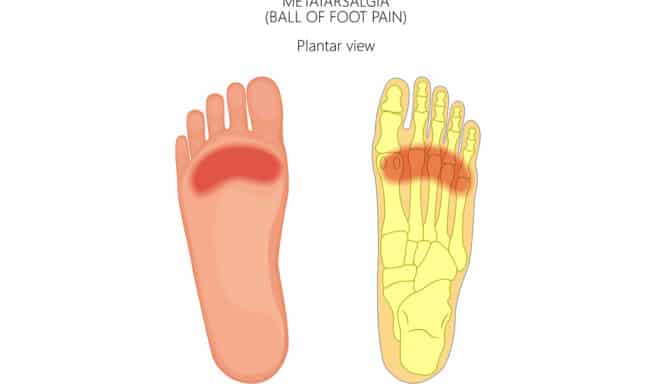
Pain around the ball of the foot
Tendon problems
Pain related to specific tendon loading or movement
Gout
Sudden, intense joint pain, redness and swelling
Stress fracture
Localized pain that may worsen with weight-bearing
Neuroma
Burning, tingling or nerve-like pain, often between the toes
Bursitis
Localized tenderness and inflammation
Inflammatory arthritis
Joint pain and stiffness that may affect multiple joints
This is why an assessment can be useful when foot pain persists or interferes with normal activities.
What Causes Osteoarthritis in the Feet?
There is rarely one single cause.
Factors associated with osteoarthritis can include:
Age-related changes
Previous injuries
Fractures
Repetitive joint loading
Joint instability
Abnormal or altered biomechanics
Previous surgery
Certain structural foot characteristics
Genetics
Body weight and overall joint loading
Other medical or musculoskeletal conditions
Importantly, developing osteoarthritis is not simply a consequence of "using your feet too much."
Many factors interact to influence joint health and symptoms.
How Is Osteoarthritis of the Foot Diagnosed?
A diagnosis begins with a history and physical examination.
A healthcare professional may assess:
Where your pain occurs
When your symptoms started
What activities make your symptoms better or worse
Joint range of motion
Joint tenderness
Swelling
Foot structure
Walking pattern
Foot and ankle strength
Footwear
How your foot loads during standing and walking
Imaging such as X-rays may sometimes be used to evaluate joint changes or rule out other problems.
Figure 2: What a Foot Assessment May Look At
A comprehensive foot assessment considers symptoms, joint movement, foot structure, gait, footwear, and functional goals before treatment options are recommended.
How Is Osteoarthritis in the Feet Treated?
There is no single treatment that works for everyone.
Treatment is generally aimed at reducing symptoms, improving function, maintaining mobility, and helping you continue activities that are important to you.
Depending on the individual, treatment may include several approaches.
1. Exercise and Movement
Exercise is an important part of osteoarthritis management.
Appropriately selected exercises can help maintain:
Joint mobility
Muscle strength
Balance
Physical function
General fitness
Research across osteoarthritis populations supports exercise as an important component of management, although the amount of evidence varies between different joints.
For foot and ankle arthritis, exercises may be selected to address the specific joint, surrounding muscles, balance, gait, and overall activity goals.
The goal is not necessarily to "exercise the arthritis away." Rather, movement can help maintain function and make everyday activities more manageable.
2. Footwear Changes
Footwear can have a significant impact on how comfortable an arthritic foot feels.
Depending on the affected joint, useful footwear characteristics may include:
Adequate toe room
A comfortable upper that does not press on bony areas
Appropriate cushioning
A stable sole
A sole that reduces excessive bending of a painful joint
A suitable heel height
Adequate width
For some people with big toe arthritis, footwear with a relatively stiff sole or rocker-style sole can reduce the amount the big toe has to bend during walking. However, footwear needs to be individualized because what helps one person may not work for another.
A footwear assessment can be particularly helpful when arthritis has changed the shape or movement of the foot.
3. Activity Modification
Having osteoarthritis does not necessarily mean giving up the activities you enjoy.
Instead, it may be helpful to modify:
Duration
Intensity
Frequency
Terrain
Footwear
Recovery time
For example, someone who develops pain after a long walk may be able to continue walking by temporarily reducing distance, incorporating rest periods, choosing a more suitable surface, and gradually increasing activity again.
The objective is to find a sustainable level of activity rather than simply avoiding movement.
4. Physical Therapy and Strengthening
A physiotherapist or other rehabilitation professional may recommend exercises based on your specific limitations.
Depending on the individual, this may include work on:
Foot and ankle strength
Calf strength
Joint mobility
Balance
Lower-limb strength
Walking mechanics
General conditioning
A rehabilitation program may be especially useful when arthritis has caused someone to become less active.
5. Padding and Pressure Relief
If arthritis has created a prominent or sensitive area, padding or other pressure-relieving strategies may help reduce irritation.
This can be particularly useful when a bony prominence rubs against footwear.
6. Custom Orthotics
Custom orthotics are another potential treatment option—but they are not automatically required for everyone with foot osteoarthritis.
A custom orthotic is designed to fit an individual's foot and can be used to influence how pressure is distributed beneath the foot or how the foot functions during standing and walking.
Depending on the person's foot structure and symptoms, an orthotic may be designed to:
Redistribute pressure away from a painful area
Provide support where appropriate
Accommodate a structural prominence
Reduce stress on particular parts of the foot
Work with the person's footwear
Help manage mechanical contributors to symptoms
How Custom Orthotics May Help
Custom orthotics are one potential component of a broader treatment plan. Their design should be based on the individual's symptoms, foot structure, footwear, activity and functional goals.
Do Orthotics Work for Everyone With Foot Arthritis?
No.
Evidence for orthotics varies depending on which joint is affected, what type of orthotic is used, and the individual's biomechanics and symptoms.
A recent 2026 review specifically discussing orthotics for first metatarsophalangeal joint osteoarthritis noted that average treatment effects in the research may be relatively small, while also highlighting that individual responses can vary considerably.
This is an important distinction: an orthotic should not be presented as a cure for osteoarthritis.
Instead, it may be useful when there is a specific mechanical or pressure-related reason for using one.
Research also shows that foot orthoses can alter lower-limb biomechanics, although their effects depend on the task and the type of orthosis used.
Custom Orthotics Are Only One Piece of the Puzzle
It can be tempting to look for one solution to osteoarthritis.
In reality, the most appropriate approach may involve several relatively simple strategies working together.
Osteoarthritis Management Chart
Treatment approach
What it may help with
Exercise
Strength, mobility, function and overall activity
Physical therapy
Movement, strength, balance and rehabilitation
Footwear changes
Comfort, pressure and joint loading
Activity modification
Managing symptoms while staying active
Padding/offloading
Local pressure and irritation
Custom orthotics
Pressure redistribution and individualized mechanical support
Weight management when appropriate
Overall joint loading and health
Pain-management strategies
Symptom control
Medical evaluation
Diagnosis, imaging and consideration of additional treatment
Surgery in selected cases
Severe symptoms or structural problems when conservative care is insufficient
Important: The appropriate combination depends on the individual. Not every person needs every treatment.
Can Osteoarthritis in the Feet Get Worse?
Osteoarthritis is a long-term condition, but symptoms do not necessarily worsen in a straight line.
People can have periods where symptoms are more noticeable and other periods where they are relatively comfortable.
Symptoms may flare after:
Increased walking
Higher-impact activities
Changes in footwear
Prolonged standing
A new injury
Changes in activity levels
Managing symptoms early can make it easier to maintain normal activity and function.
Can You Still Exercise With Foot Osteoarthritis?
In many cases, yes.
Exercise is generally an important part of osteoarthritis management.
The key is finding activities and exercise levels that are appropriate for your symptoms and physical abilities.
Depending on the person, options may include:
Walking
Cycling
Swimming
Strength training
Mobility exercises
Balance exercises
Low-impact cardiovascular exercise
If an activity consistently causes significant pain, swelling, or a prolonged increase in symptoms, it may need to be modified.
A healthcare professional can help determine an appropriate exercise approach.
When Should You Have Foot Pain Assessed?
Consider having persistent foot pain evaluated if:
Pain is interfering with walking
Your foot feels increasingly stiff
You have difficulty finding comfortable shoes
You notice swelling around a joint
Your walking pattern has changed
Pain is limiting your normal activities
Symptoms are getting progressively worse
You have had a previous foot or ankle injury
You are unsure whether your pain is actually caused by arthritis
Sudden, severe pain, significant swelling, redness or warmth, an inability to bear weight, or symptoms following a significant injury may require prompt medical assessment.
How Feet First Clinic Can Help
At Feet First Clinic, a foot assessment can help identify what may be contributing to your foot pain and how osteoarthritis is affecting your movement and daily activities.
An assessment may look at:
Your symptoms and medical history
Joint range of motion
Foot structure
Pressure-sensitive areas
Foot and ankle mechanics
Walking pattern
Footwear
Activity-related symptoms
From there, your chiropodist can discuss treatment options appropriate to your situation.
These may include footwear recommendations, exercises or referrals for rehabilitation, padding and pressure-relief strategies, and—when appropriate—custom orthotics.
Considering Custom Orthotics?
If your assessment suggests that an orthotic could be useful, Feet First Clinic can assess your feet and discuss whether a custom device makes sense for your particular symptoms.
The goal is not simply to put an orthotic in every arthritic foot. The goal is to determine whether changing how the foot is supported or loaded could be useful for you.
Custom orthotics may be particularly worth discussing when:
A specific area of the foot is consistently overloaded
Foot structure contributes to symptoms
A painful joint needs additional offloading
Footwear alone is not providing enough support or comfort
You have biomechanical factors that may be contributing to your symptoms
A custom orthotic can also be considered as part of a broader plan that includes appropriate footwear, exercise, activity modification and other treatments.
Experiencing foot pain or stiffness that may be related to osteoarthritis? Book a foot assessment at Feet First Clinic to have your symptoms, foot mechanics and footwear evaluated and discuss treatment options that may be appropriate for you.
Frequently Asked Questions About Osteoarthritis of the Feet
What are the symptoms of osteoarthritis in the feet?
Common symptoms include joint pain, stiffness, swelling, reduced range of motion, tenderness and difficulty walking. Symptoms often become more noticeable with activities that load the affected joint.
What part of the foot is most commonly affected by osteoarthritis?
Osteoarthritis can affect several foot and ankle joints. The big toe joint and midfoot are common areas of concern, while the ankle can also develop osteoarthritis, particularly after previous injury.
Can osteoarthritis cause pain on the top of the foot?
Yes. Osteoarthritis affecting joints in the midfoot can cause pain, stiffness or tenderness across the top of the foot. A bony prominence may also develop and become irritated by footwear.
Can osteoarthritis cause big toe pain?
Yes. Osteoarthritis of the big toe joint can cause pain, stiffness and reduced movement. This is commonly associated with hallux rigidus.
Can you walk with osteoarthritis in your feet?
Many people with foot osteoarthritis continue to walk and remain active. Treatment focuses on managing symptoms, maintaining mobility and finding ways to make activity more comfortable.
Are orthotics good for foot osteoarthritis?
Orthotics may help some people, particularly when there is a specific pressure or mechanical factor that can be addressed with an orthotic. However, orthotics do not work for everyone and are not a cure for osteoarthritis. Evidence varies depending on the joint affected and the type of orthotic used.
Can custom orthotics cure osteoarthritis?
No. Custom orthotics do not reverse or cure osteoarthritis. They may help manage symptoms by changing pressure distribution or supporting particular aspects of foot mechanics in appropriately selected patients.
What shoes are best for foot osteoarthritis?
The best shoe depends on which joint is affected, your foot shape and your symptoms. Features that may help include adequate toe room, appropriate cushioning, a comfortable upper and a sole that does not aggravate the painful joint. Some people with big toe arthritis may find a stiffer or rocker-style sole more comfortable.
Should I stop exercising if I have osteoarthritis in my feet?
Not necessarily. Exercise is an important part of osteoarthritis management. The type and amount of exercise may need to be modified based on symptoms and physical ability.
Does osteoarthritis in the feet get worse with age?
Age is one risk factor for osteoarthritis, but symptoms do not necessarily progress at the same rate in everyone. Previous injuries, joint structure, activity, body weight and other factors can influence symptoms and joint health.
Do I need an X-ray to diagnose foot osteoarthritis?
Not always. A clinical assessment can provide important information. Imaging may be recommended when a healthcare professional needs to investigate joint changes, confirm a diagnosis or rule out another condition.
When should I see a chiropodist for foot arthritis?
Consider a foot assessment if persistent pain or stiffness is affecting your walking, activities or footwear, or if you are unsure what is causing your symptoms. A chiropodist can assess the foot and discuss appropriate conservative treatment options.
The Bottom Line
Osteoarthritis can affect the feet in several ways, from painful and stiff big toe joints to midfoot or ankle pain that makes walking more difficult.
There is no single "best" treatment for everyone.
A balanced approach may include exercise, appropriate footwear, activity modification, rehabilitation, pressure relief, pain-management strategies and, for some people, custom orthotics.
The most useful treatment plan is one that matches the affected joint, your symptoms, your foot mechanics and the activities you want to continue doing.
If foot pain or stiffness is affecting your everyday life, a foot assessment at Feet First Clinic can help determine what may be contributing to your symptoms and whether options such as footwear changes, custom orthotics or other conservative treatments may be appropriate.
Book a foot assessment with Feet First Clinic to better understand your foot pain and explore treatment options tailored to you.
 Open
Open