Open
Open


October 8, 2026
Have you walked around downtown Toronto with the feeling that you have a pebble stuck in your shoe? It can turn into a persistent nuisance that negatively impacts your daily exercise or routine. If this sounds like you, you may be experiencing a nerve compression syndrome which affects the nerves located at the base of the toes, called a neuroma.
The most common nerve to be affected is the one found at the ball of the foot, between the third and fourth toes. This nerve is naturally thicker than the rest, putting it at higher risk of developing a neuroma. A neuroma at this specific location on the foot is called Morton’s Neuroma. Irritation of the nerve at this location causes the nerve to enlarge or swell, making it more vulnerable to compressive stresses.
What Are The Symptoms Of Morton's Neuroma?
Localized pain that radiates to the toes when wearing shoes or while walking.
Feeling like you’re walking on a pebble.
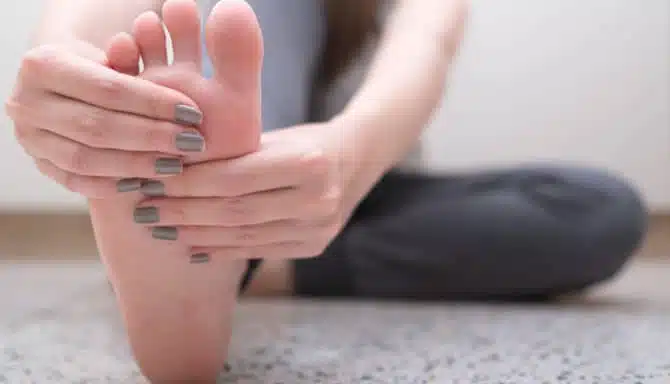
Numbing, tingling, or burning sensation in your foot and feeling like you have to take off your shoes to rub it for relief.
Sharp pain in your foot.
Pain that radiates from the ball of your foot to your toes.
Photo by Artem Beliaikin from Pexels - Thank you!
What Causes Morton's Neuroma?
It is very likely that the cause of your neuroma is poor foot mechanics, with the most common one being overpronation. Overpronation is the involuntary act of rolling the ankles towards the arches as one walks. As the foot pronates more than it should, the metatarsals also move more than they should. This leads to compression and subsequent irritation of the nerves, resulting in pain and inflammation.
How Can I Treat Morton's Neuroma?
Your goals should be to:
Remove pressures from the area of concern.
Allow the nerve to heal.
Prevent future incidences of discomfort.
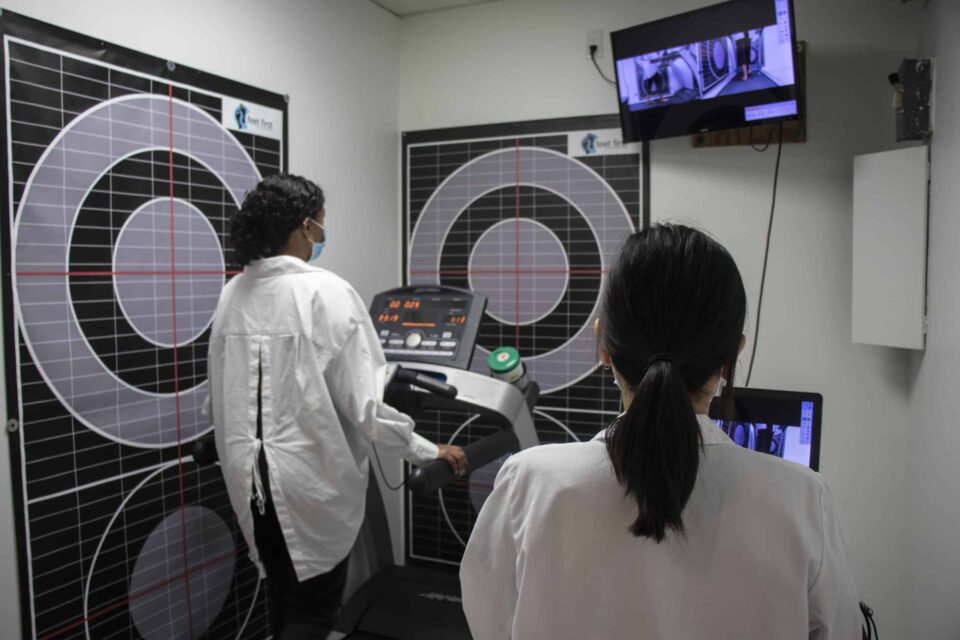
In summary, overhauling your footwear can make the biggest difference. Booking an appointment with a qualified foot specialist is a great next step. A chiropodist will perform a biomechanical assessment and gait analysis to identify the root cause of your Morton's neuroma. From there, they can assess your foot type, evaluate your walking pattern, and recommend appropriate footwear.
If underlying biomechanical issues are present, custom-made orthotics may be prescribed to improve foot mechanics, control pronation, and redistribute pressure away from the neuroma. These often include features like a metatarsal dome pad, which helps relieve nerve pressure by gently splaying the metatarsal bones.
For more immediate relief, over-the-counter metatarsal pads can be added to your existing insoles. Choosing shoes with a wider fit, a roomy toe box, and a lower heel can also significantly reduce discomfort and help prevent symptom flare-ups.
Finally, if more conservative treatments aren’t providing relief, ultrasound-guided steroid injections may be considered. This involves delivering a corticosteroid (a powerful anti-inflammatory) directly to the affected area while using ultrasound imaging to precisely target the nerve. By placing the medication exactly where it’s needed, this approach helps reduce inflammation around the nerve and can provide relatively fast, effective pain relief.
September 24, 2026
Pain in the ball of your foot can make walking, standing, running and even wearing shoes uncomfortable. One common cause is metatarsalgia, a general term for pain affecting the forefoot around the metatarsal bones.
Metatarsalgia can develop gradually or appear after an increase in activity. It may be related to footwear, foot structure, repetitive impact, pressure distribution, or another underlying foot condition.
The good news is that many cases of metatarsalgia can be managed with conservative treatment, including activity modification, footwear changes, cushioning, metatarsal pads, exercises and orthotic support. The right treatment depends on what is causing the pain.
Key Takeaways
Metatarsalgia is pain in the ball of the foot, usually around the metatarsal heads beneath the toes.
It can be caused by increased activity, footwear, foot structure, altered foot mechanics, or excessive pressure on the forefoot.
Common symptoms include aching, burning, sharp pain, tenderness, or a feeling like there is a pebble in your shoe.
Treatment often focuses on reducing pressure on the forefoot, improving footwear, modifying activities and using appropriate cushioning or metatarsal support.
Metatarsal pads and orthotics may help some people by redistributing pressure, depending on the individual's foot structure and symptoms.
Ball-of-foot pain isn't always metatarsalgia. Conditions such as Morton's neuroma, stress fractures, sesamoiditis and arthritis can cause similar symptoms.
If pain is persistent, worsening or interfering with walking, a professional foot assessment can help identify the underlying cause.
Experiencing pain in the ball of your foot? Feet First Clinic can help identify possible causes of your forefoot pain and develop a treatment approach based on your individual needs.
Book an assessment with a Feet First Clinic chiropodist to have your foot pain evaluated.
What Is Metatarsalgia?
Metatarsalgia is pain and irritation in the ball of the foot, usually around the heads of the metatarsal bones just behind the toes.
The five metatarsal bones connect the middle of the foot to the toes. When excessive or uneven pressure is placed on the forefoot, the tissues around the metatarsal heads can become painful.
Metatarsalgia isn't necessarily one specific disease. Rather, the term describes a pattern of forefoot pain that can have several different contributing factors.
Common symptoms include:
Aching or sharp pain in the ball of the foot
Burning pain
Pain that becomes worse with walking, running or standing
Pain when pushing off the toes
Tingling or numbness in some cases
A sensation that there is a pebble or small stone inside the shoe
Calluses developing underneath areas of increased pressure
Mayo Clinic and Cleveland Clinic both describe pain in the ball of the foot as the characteristic location of metatarsalgia, with symptoms often becoming worse with standing, walking or high-impact activity.
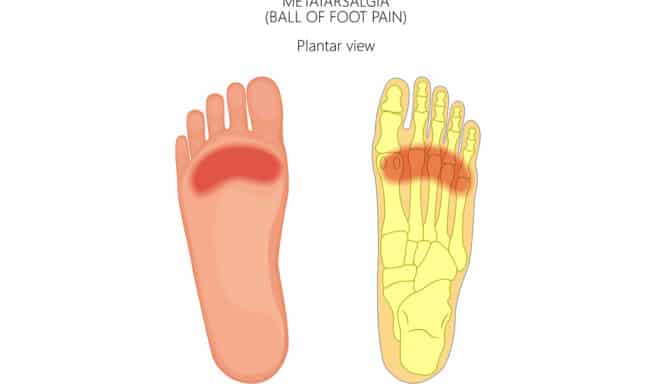
Figure 1: Where Is Metatarsalgia?
Metatarsalgia commonly causes pain around the ball of the foot beneath one or more metatarsal heads.
Figure caption: Metatarsalgia commonly causes pain around the ball of the foot beneath one or more metatarsal heads.
What Causes Metatarsalgia?
There isn't always one single cause. In many cases, several factors contribute to increased pressure on the forefoot.
1. Increased Activity
Running, jumping and other high-impact activities place substantial forces through the forefoot.
A sudden increase in mileage, training intensity or activity can therefore contribute to forefoot pain.
This is particularly relevant for runners and people participating in sports involving repeated running and jumping.
2. Poorly Fitting Footwear
Shoes that are too tight, too loose, excessively high-heeled or otherwise unsuitable for your activity can increase pressure on the forefoot.
A narrow toe box may also crowd the toes and alter how pressure is distributed through the front of the foot.
3. Foot Structure and Mechanics
Certain foot shapes or structural changes can increase pressure under the metatarsal heads.
Examples can include:
High arches
Flat feet
Bunions
Hammertoes
A relatively long second toe
Changes in the position of the metatarsal bones
Abnormal pressure distribution during walking
4. Calluses
A thick callus underneath the forefoot can be a sign that repeated pressure is occurring in that area.
The callus itself may contribute to discomfort, but it can also provide a clue about where excessive pressure is being concentrated.
5. High Heels
High-heeled footwear shifts more body weight toward the front of the foot, potentially increasing pressure around the metatarsal heads.
6. Foot and Joint Conditions
Forefoot pain can also be associated with conditions such as:
Morton’s neuroma
Arthritis
Gout
Sesamoiditis
Stress fractures
Inflammatory conditions
Hammertoes
Bunions
Because several conditions can produce similar symptoms, identifying the source of the pain is important before deciding on treatment.
Metatarsalgia Causes at a Glance
Possible contributing factor
How it may affect the forefoot
Increased running or jumping
Repeated impact can increase forefoot loading
High heels
Shifts more pressure toward the front of the foot
Narrow footwear
Can crowd the toes and alter pressure distribution
High arches
May concentrate pressure under the forefoot
Bunions
Can change how weight is distributed
Hammertoes
May alter forefoot loading
Calluses
Can indicate areas of repeated pressure
Foot mechanics
May affect how force moves through the foot
Previous injury
Can change movement and pressure distribution
Other conditions
Neuroma, arthritis, stress fracture and other problems can mimic or contribute to forefoot pain
What Does Metatarsalgia Feel Like?
People describe metatarsalgia in different ways.
The pain may feel:
Sharp
Aching
Burning
Shooting
Tender or bruised
Like there is a pebble in the shoe
Symptoms may become more noticeable when walking, running, standing for long periods or pushing off through the toes.
Some people also experience numbness or tingling in the toes.
QUICK ANSWER
What does metatarsalgia feel like?
Metatarsalgia usually feels like pain, aching or burning underneath the ball of the foot. Some people describe the sensation as walking on a pebble. Pain often becomes worse with walking, running or prolonged standing.
Metatarsalgia vs. Other Causes of Ball-of-Foot Pain
Not every case of pain under the toes is metatarsalgia.
Condition
Typical clues
Metatarsalgia
Pain or tenderness beneath one or more metatarsal heads
Morton’s neuroma
Burning, shooting or nerve-like pain, often between the toes
Stress fracture
Localized pain that may worsen with activity and require imaging to investigate
Sesamoiditis
Pain beneath the big toe joint around the sesamoid bones
Arthritis
Joint pain, stiffness and reduced movement
Callus-related pressure
Localized tenderness beneath a thickened area of skin
These conditions can overlap, and symptoms alone may not establish the exact cause. A healthcare professional may examine the foot and, when appropriate, use imaging to rule out other problems such as a stress fracture.
How Is Metatarsalgia Diagnosed?
A healthcare professional will generally start by asking about:
Where the pain occurs
When it started
What activities make it worse
Your footwear
Your exercise routine
How much time you spend standing or walking
Previous injuries or foot problems
The foot may be examined while sitting and standing, and your walking pattern may also be assessed.
Depending on the symptoms, imaging such as an X-ray may be considered to investigate other possible causes of pain. Ultrasound or MRI may sometimes be used when soft-tissue problems need further evaluation.
Experiencing Ball-of-Foot Pain?
If pain in the ball of your foot is making it uncomfortable to walk, exercise or stand for long periods, a professional assessment can help determine what's contributing to your symptoms.
At Feet First Clinic, our licensed chiropodists can assess your feet, footwear and the factors contributing to your forefoot pain. Depending on your individual needs, treatment may include footwear recommendations, metatarsal pads, insoles or orthotics, activity recommendations and other appropriate foot-care options.
You don't have to simply live with ongoing foot pain.
Book an appointment at Feet First Clinic for an assessment of your ball-of-foot pain.
Figure 2: How a Foot Assessment Works
How a Foot Assessment Works: A foot assessment evaluates your symptoms, foot structure, joint movement, and gait to help identify the possible cause of foot pain and determine whether further testing or conservative treatment is appropriate.
How Do You Treat Metatarsalgia?
Treatment for metatarsalgia focuses on reducing excessive pressure on the painful area and addressing the factors contributing to the problem.
Treatment may include:
1. Reduce Aggravating Activities
If running, jumping or another activity is causing pain, temporarily reducing the activity can give irritated tissues an opportunity to settle.
Low-impact activities such as cycling or swimming may allow you to remain active while reducing repetitive impact on the forefoot.
2. Choose Supportive Footwear
Footwear can make a significant difference.
Look for shoes that provide:
Adequate room for the toes
Appropriate cushioning
A supportive sole
A comfortable fit
Enough space around the forefoot
A design appropriate for your activity
Avoid shoes that squeeze the toes or place excessive pressure on the ball of the foot.
3. Consider a Metatarsal Pad
A metatarsal pad can redistribute pressure away from the painful area.
Important: placement matters.
A metatarsal pad is generally positioned behind the metatarsal heads rather than directly underneath the most painful spot. Correct placement can help redistribute pressure through the forefoot.
Mayo Clinic specifically lists metatarsal pads and arch supports among conservative measures that may reduce stress on the metatarsal bones.
4. Try an Appropriate Insole or Orthotic
An insole or orthotic may help redistribute pressure and provide support depending on the underlying mechanics.
Not everyone with metatarsalgia needs a custom orthotic. Some people may benefit from an appropriate over-the-counter insert, while others may require a more individualized device.
Orthotic treatment should be based on the individual's foot structure, symptoms and activity needs.
5. Address Contributing Foot Problems
If a bunion, hammertoe, callus, altered gait pattern or another foot problem is contributing to excessive forefoot pressure, addressing that factor may be an important part of treatment.
6. Ice and Rest
Ice and temporary activity modification may help reduce discomfort, particularly following activities that aggravate the area. Mayo Clinic recommends applying an ice pack for approximately 20 minutes at a time, with a towel protecting the skin.
A diagram showing the roadmap for treating metatarsalgia/ball-of-foot pain
Can Orthotics Help Metatarsalgia?
Orthotics may help some people with metatarsalgia by redistributing pressure and supporting the foot.
An orthotic can be designed or selected to address factors such as pressure distribution, arch support and foot mechanics.
However, there is no single orthotic that is appropriate for every person with metatarsalgia.
Depending on the individual, treatment may involve:
An over-the-counter insole
An accommodative insert
A metatarsal pad
A custom orthotic
A combination of footwear and orthotic modifications
The goal is not simply to add more cushioning. The goal is to address the factors contributing to the forefoot pain.
Cleveland Clinic notes that orthotics can range from simple shoe inserts to custom devices and may be used for forefoot pain including metatarsalgia.
Can Shoes Cause Metatarsalgia?
Yes. Footwear can contribute to metatarsalgia.
Shoes that are too narrow, poorly fitted, excessively high-heeled or inappropriate for an activity can increase stress on the forefoot.
When choosing footwear for metatarsalgia, consider:
Toe box:
Your toes should have enough room to spread naturally without being compressed.
Sole:
A supportive and appropriately cushioned sole can reduce the impact placed on the forefoot.
Fit:
Shoes should not squeeze the ball of your foot or allow excessive movement inside the shoe.
Activity:
Choose footwear designed for the activity you're performing.
What Exercises Can Help Metatarsalgia?
Exercises may be useful when appropriate, particularly when limited mobility, muscle weakness or altered foot mechanics are contributing to symptoms.
Depending on the individual, a healthcare professional may recommend exercises involving:
Calf stretching
Ankle mobility
Toe mobility
Foot-strengthening exercises
Balance exercises
Gradual strengthening of the intrinsic foot muscles
Exercises should not significantly increase pain. If an exercise consistently aggravates symptoms, stop and seek professional guidance.
When Should You See a Healthcare Professional?
Consider having persistent ball-of-foot pain assessed if:
Pain continues despite changing footwear and reducing aggravating activities
Pain is getting worse
You have significant swelling
You cannot comfortably bear weight
You have numbness or persistent tingling
Pain started after an injury
You suspect a stress fracture
Pain is interfering with your normal activities
You have diabetes or another condition that increases your risk of foot complications
Persistent forefoot pain can have causes other than metatarsalgia, so an assessment can help determine whether further investigation is appropriate.
Can Metatarsalgia Be Prevented?
Not every case can be prevented, but you can reduce some contributing factors.
Helpful habits include:
Wear properly fitting footwear.
Choose shoes with adequate toe room.
Replace excessively worn footwear.
Increase exercise intensity gradually.
Use activity-specific footwear.
Avoid prolonged use of uncomfortable high heels.
Address recurring calluses or pressure points.
Consider appropriate support if your feet require it.
Don't ignore persistent forefoot pain.
Cleveland Clinic specifically recommends footwear with good soles, a wide toe box and a lower heel as part of prevention strategies.
Metatarsalgia: Frequently Asked Questions
What is metatarsalgia?
Metatarsalgia is a term used to describe pain affecting the ball of the foot, particularly around the metatarsal heads beneath the toes.
What causes metatarsalgia?
Common contributing factors include increased running or jumping, poorly fitting footwear, high heels, foot structure, bunions, hammertoes, calluses and other conditions that increase pressure on the forefoot.
What does metatarsalgia feel like?
It can feel like aching, sharp, burning or shooting pain in the ball of the foot. Some people describe feeling as though there is a pebble in their shoe.
How do you get rid of metatarsalgia?
Treatment depends on the cause. Common conservative approaches include reducing aggravating activity, changing footwear, using appropriate cushioning or metatarsal pads, and addressing foot mechanics. Persistent symptoms should be assessed by a healthcare professional.
Can walking make metatarsalgia worse?
Yes. Walking, running and prolonged standing can increase pressure through the forefoot and may aggravate symptoms.
Can running cause metatarsalgia?
Running and other high-impact activities can contribute to metatarsalgia because they place repeated forces through the forefoot. A sudden increase in training volume or intensity may increase the risk.
Are metatarsal pads good for metatarsalgia?
Metatarsal pads may help redistribute pressure away from painful areas of the forefoot. Their position is important, and the appropriate type and placement can vary between individuals.
Can orthotics help metatarsalgia?
They can help some people by supporting the foot and redistributing pressure. The appropriate type of orthotic depends on the person's foot structure, symptoms and contributing factors.
What shoes are best for metatarsalgia?
Generally, look for footwear with adequate toe room, a comfortable fit, appropriate cushioning and a sole that provides suitable support for your activity. Avoid shoes that squeeze the forefoot or place excessive pressure on the ball of the foot.
How long does metatarsalgia take to heal?
Recovery varies depending on the underlying cause, severity and whether the contributing factors are addressed. Mild cases may improve with activity modification and footwear changes, while persistent symptoms may require further assessment and treatment.
Is metatarsalgia serious?
Metatarsalgia itself is not usually considered a serious condition, but persistent ball-of-foot pain should not automatically be assumed to be metatarsalgia. Other conditions, including stress fractures and nerve problems, can produce similar symptoms.
When should I see a foot specialist for metatarsalgia?
If your pain persists, worsens, affects your ability to walk or does not improve after changing footwear and modifying activities, a foot assessment can help determine the likely cause and appropriate treatment.
The Bottom Line
Metatarsalgia is pain in the ball of the foot that can result from increased forefoot pressure, footwear, activity, foot structure or another underlying condition.
Treatment usually begins with conservative measures such as:
1. Reducing aggravating activities
2. Improving footwear
3. Reducing pressure on the forefoot
4. Using appropriate cushioning or metatarsal support
5. Addressing contributing foot mechanics or conditions
If ball-of-foot pain persists or you are unsure what is causing it, a professional foot assessment can help distinguish metatarsalgia from other causes of forefoot pain.
Sources
Mayo Clinic — Metatarsalgia: symptoms, causes, diagnosis and treatment.
Cleveland Clinic — Metatarsalgia: symptoms, causes, diagnosis and treatment.
Cleveland Clinic — Orthotics: types, benefits and uses for forefoot pain.
September 10, 2026
If your sports injury isn’t something that’ll heal overnight, it’s time to think long-term. Here are a few ways to speed up recovery and lower your risk of re-injury:
Don’t Go Back to Working Out without Permission!
Before you ease back into your routine, you need to consult a medical professional to see if they give you the go-ahead. You may feel like you’re ready to get back on the treadmill or jump back onto the basketball court, but that doesn’t mean you actually are. Getting back into your regular routine could sabotage the progress you’ve made.
Go for Low-Impact Activities!
Certain types of activities will be easier on your body than others. You should incorporate low impact exercises into your workout routine to stay in shape during your recovery period.
Swimming is an excellent low-impact exercise. The water supports your weight, so going through the motions won’t put a strain on your joints. If you’re not a strong swimmer, you can still put on your bathing suit for water aerobics — this is a workout routine that takes place in the shallow end of the pool. It’s famous for helping people with sports injuries, osteoarthritis and other physical complications.
Restorative yoga is also a great option—it’s low-intensity and adaptable to different physical limitations. Just let your instructor know about your injury ahead of time so they can modify poses to suit you.
Make Yourself Comfortable!
Get yourself the right equipment to ease the discomfort of your injury and make your day to day less of a hassle. For instance, someone dealing with ankle pain could benefit from a biomechanical assessment to see if they should get orthopedic shoes or custom orthotics. The additional cushioning from specialized footwear could reduce discomfort by taking some pressure off of the joint, while the added support could also protect the ankle from re-injury.
Here are some more products that can combat the aches and pains from sports injuries:
Braces/stabilizers/supports
Athletic tape
Pillows
Ice packs
Heating pads
What If You’re Not Sure That You’re Injured?
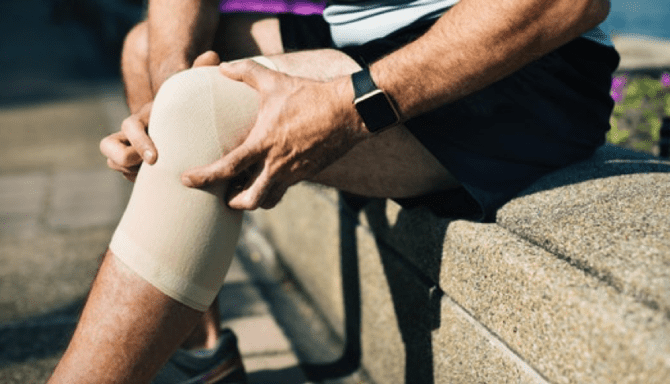
Not sure whether your Achilles pain or sore knees are from a sports injury or just a sign you need rest? It’s worth getting it checked out. A chiropodist can review your symptoms, perform an exam, and assess your gait to look for movement patterns that may be contributing to the issue.
If further investigation is needed, you’ll typically need to see a physician first to get a referral for medical imaging, such as an ultrasound or X-ray.
Sports injuries can be frustrating, especially when you just want to get back to your routine. But recovery takes time. Pushing through pain or ignoring your limits can often make things worse rather than better.
September 3, 2026
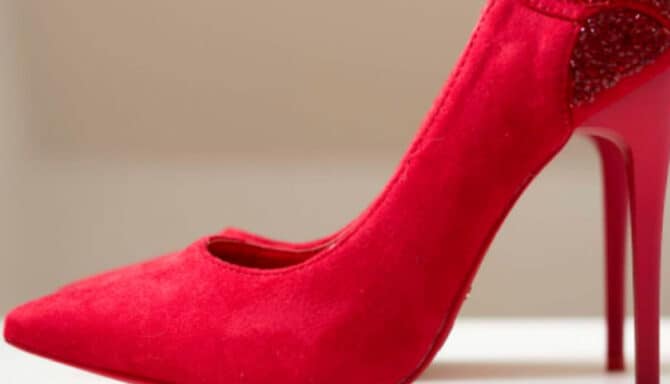
Whether it’s a pair of black patent leather pumps, sky-high ruby red stilettos or strappy sandals, high heels are considered wardrobe staples that belong in a woman’s closet. They’re used for special occasions and everyday work-life, going out dancing or going for an important interview. Sadly, these beloved fashion statements can damage parts of your body over time.
Anyone who has ever worn a pair of high heels knows that after a few hours of standing and walking, your feet are throbbing. It’s a relief just to slip them off, sit down and let your pulsing toes have a little bit of a rest. These aches and pains come after only a few hours of wearing the shoes — the long-term effects are much worse. There are many different ways that high heels can harm not just your feet, but your entire body.
Bunions
One of the health problems that people can get from wearing high heels is developing large bumps called bunions on the outsides of their big toes. A bunion is a permanent, progressive side-effect. The only way to reverse it is corrective surgery to remove part of the bone and adding screws to keep the foot in an appropriate position.
While bunions cannot be reversed, the progression can be managed. One way is to avoid high heels, which will aggravate the issue. It's also important to get a foot assessment with a chiropodist: bunions are usually caused or contributed to by an underlying biomechanical issue, so addressing that is the first step.
Hammertoes
Another one of the distressing things that high heels do to your feet is create hammertoes, which is when your little toes bend and buckle from the pressure of standing on them. Hammertoes are awkward and sometimes painful. Flexible hammertoes can be reversed through physiotherapy, orthopedic shoe replacements or corrective surgery.
Joint Damage
Other than foot problems, high heels prematurely age your joints because they don't allow your knee to straighten to accommodate for the additional weight placed on your legs. The reflex changes your gait (how you walk) and wears down your knees over time.
Achilles' Tendonitis & Haglund's Deformity
Regular use of high heels can lead to shortened Achilles' tendons, which can create tendinitis issues - and with that comes a lot of ankle pain. The Achilles tendon is the tendon at the back of our heel that connects our heel to our knee. A shortened Achilles tendon will also cause rubbing and pressure on the back of the heel creating a bump known as a Haglund's deformity, which is permanent spurring and deformation of the heel bone. For those who wear high heels because they want their feet to look nice, a deformity on the heel can be quite counter-productive.
Back Pain
You’ll also find that high heels cause lower back pain by forcing your lower back to arch to compensate for the fact that you’re balancing your body weight on the balls of your feet. High heels induce a forward pelvic tilt, which forces the lower back into a more exaggerated curve. The shoes force your body weight to pull forward, so you lean back when you stand. The position puts a lot of stress on your spinal discs. Sticking with the shoes can lead to poor posture, persistent aches and muscle spasms. It can also lead to chronic lower back, hip and knee pain.
Skin & Toenail Issues
High heels place excess pressure on the forefoot. With pressure, comes friction, which can lead to painful corns, calluses and blisters. The increased pressure on the big toe, especially if your high heels are also narrow, can also lead to ingrown toenails.
Alternatives to High Heels
Sometimes it's hard to avoid high heels altogether, but there are alternatives:
Reduce the frequency with which you wear high heels
Invest in orthopaedic high heels with a wider toebox, cushioned forefoot, and thick heel.
Try supportive insoles for high-heels.
Try dress flats instead.
While not a perfect solutions, these suggestions will give your feet a little extra support and mitigate the damage from wearing high heels.
It’s clear that high heels are not worth the aches and pains that they put you through. These fashion fundamentals damage your feet, your knees and your back much more than you think. Push those sandals, stilettos and pumps to the back of the closet — it’s time to change up your footwear.

August 13, 2026
It’s easy to assume that bad footwear will only hurt your feet, but it can quickly create a domino effect hitting other parts of the body. Unsupported shoes impact your foot position, which impacts your posture, which impacts your spine and back muscles.
Shoes that Cause Back Pain
For example, high heels put pressure on the balls of your feet and push your legs forward — to compensate for the shift in weight the upper-body tilts backward. The balancing act changes your straight up-and-down posture, forcing you to arch your lower back and to stick your pelvis forward. The position strains the spine and the lower back muscles.
Flat shoes like flip flops also lead to back pain because they offer no arch-support or grip whatsoever. The design changes your gait by forcing you to put more weight onto the outside edges of your foot in place of an unsupported heel. The weight disbursement alters the rotation of your legs while walking, putting more stress onto the lower spine.
Another factor that can contribute to back pain is poor shock absorption. Shoes that provide little to no cushioning—often flat shoes with thin midsoles—can increase strain on the body. Each step we take generates impact that must be absorbed somewhere. Normally, footwear helps reduce this force, but when shoes lack proper shock absorption, the impact travels through the feet, up the knees, and into the lower back. Over time, this repeated stress can place excess strain on the joints in the lower back and contribute to back pain.
Solutions for Back Pain
Replace Unsupportive Footwear
The first step to alleviating back pain is to get rid of unsupportive footwear.
Instead, opt for shoes with good cushioning and thicker midsoles designed for shock absorption. Materials like cork and EVA are naturally shock absorbent and help reduce the impact each step has on your spine.
It’s also a good idea to swap out flip flops for supportive sandals that offer cushioning, arch support, and ideally an ankle strap. An ankle strap helps keep the sandal securely on your foot and prevents toe clawing, which can otherwise alter your gait when you walk.
Finally, instead of traditional high heels, consider supportive flat dress shoes. If you must wear heels, choose shoes with a thicker block heel and keep the height under two inches to help minimize strain on your spine.
Custom Orthotics
Another way to tackle back pain is by using orthotic inserts in your shoes—although they won’t work with certain footwear styles, such as flip flops.
One of the clearest signs that you may benefit from custom orthotics is chronic pain in your feet, ankles, legs, hips, or lower back. Orthotics are commonly used to help alleviate back pain by improving alignment, supporting the feet, and promoting better posture.
Orthotics are inserts that fit inside your shoes to provide additional support, stability, and cushioning while improving overall function. For the best results, these inserts can be customized to your unique foot size, shape, and arch type.
As an added benefit, custom orthotics can also help people dealing with common foot problems. Individuals living with bunions, plantar fasciitis, or heel spurs often benefit from these medical-grade devices because they help redistribute pressure and improve the way the foot moves during walking.
To get custom orthotics, you would typically book a biomechanical assessment with a licensed chiropodist. During this assessment, the chiropodist will evaluate the range of motion in your feet and ankles, examine how you bear weight, and perform a gait analysis to determine your walking pattern. Based on their findings, they can provide a diagnosis and, if appropriate, cast your feet for custom orthotics designed to suit your footwear and daily activities.
Other Solutions for Back Pain
Some simple home remedies for back pain are cold and hot therapies — start by addressing the pain with a cold compress, then use a hot water bottle on the same area two days later. The cold will combat pain and swelling. Heat will improve blood circulation and relax tightness.
If the pain is severe enough to keep you in bed for longer than a few hours or if it has you cancelling your plans for the next day, you should see a doctor. Sharp and intense back pain is not going to be caused by your footwear, but it can be exacerbated by it. The last thing you want when you have a slipped disc or a pulled muscle is an unsupported pair of shoes.
April 30, 2026
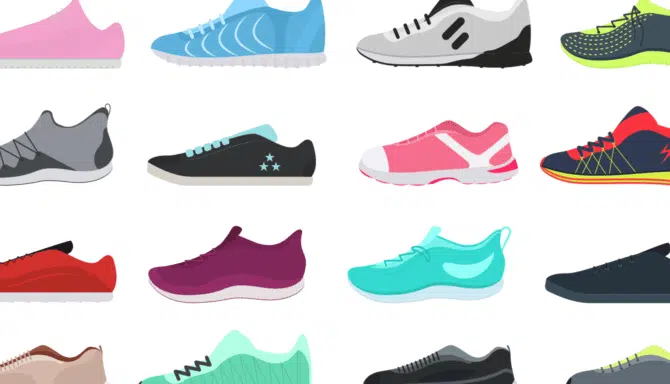
Our feet are what hold us up --- every single day! Whether it's at work for 8 hours or more, or during our morning exercise routine, healthy feet are essential for many of our daily activities. Therefore, you should invest in your foot health. Improper footwear can lead to various foot conditions, so you're better off ditching those bad shoes and looking for the perfect fit. Knowing the right shoe for you is important, but narrowing them down based on your specific foot type can be challenging. To help educate you on the differences, we will break down the 2 most common types of footwear. Keep in mind, we're not talking about high heels, sneakers, etc. We're specifically breaking down the 2 types of footwear based on their structural characteristics and how they will compliment your feet.
Importance of Knowing Your Arch Mechanics
It’s important to learn the structure of your feet, specifically your arch, as it provides some hints as to what the best shoe might be for you. A simple test, called the Wet test, can help sometimes determine your arch type. But to know for sure, it's recommended to get a foot assessment by a chiropodist.
The wet test process:
Dip the soles of your feet into water.
Stand on a piece of paper.
When you step off, you should see an imprint of your foot which will show you your arch type.
Seeing half of your arch (the middle portion of your foot) indicates a normal arch, while seeing the majority of your arch on the paper indicates you have flat feet (or a low arch). Conversely, seeing minimal arch indicates a high arch. Now that we know this, we can look into the 3 types of footwear.
2 Main Types of Footwear are:
Stability
Neutral
Stability
Normal, flat and low arches are best suited for stability footwear. Stability footwear is the most supportive and corrective. Stability essentially prevents excessive pronation (inward movement) of your foot, which reduces strain and pressure on the joints and muscles in the feet. To correct overpronation (when your foot rolls too far inward), these shoes have medial support - called a medial post - built into the midsole.
Stability shoes also feature a firm heel counter for ankle support. The additional ankle support in stability shoes also makes them great for people who don't overpronate but may have ankle instability, such as people with Achilles tendonitis.
Neutral
As the name implies, neutral cushioned shoes do not have medial support or features within the midsole. With neutral shoes, there is simply cushioning, and no wedges or stiff plastic support along the arch. This can prevent any sort of under or overcompensation when walking or running. Overall, the structure of the shoe is relatively symmetrical.
Regular pronators and supinators (when your foot fails to roll inwards and instead applies pressure to your outer foot) should consider using neutral shoes because any stability features would be moot.
Final Advice
It’s important to note that the amount of cushioning is not necessarily an indicator of the type of shoe, but rather it’s a combination of medial features, stiff plastic, and other factors. Cushioning can also be stiff, or soft, depending on the denseness and type of foam.
Ultimately, and as The Mayo Clinic notes, “there is no one best shoe or a particular foot type, and comfort and proper fit should be the main criteria you use when selecting new athletic shoes.”
Now that you're aware of the 3 types of footwear, you can asses your needs and make the right footwear choices!